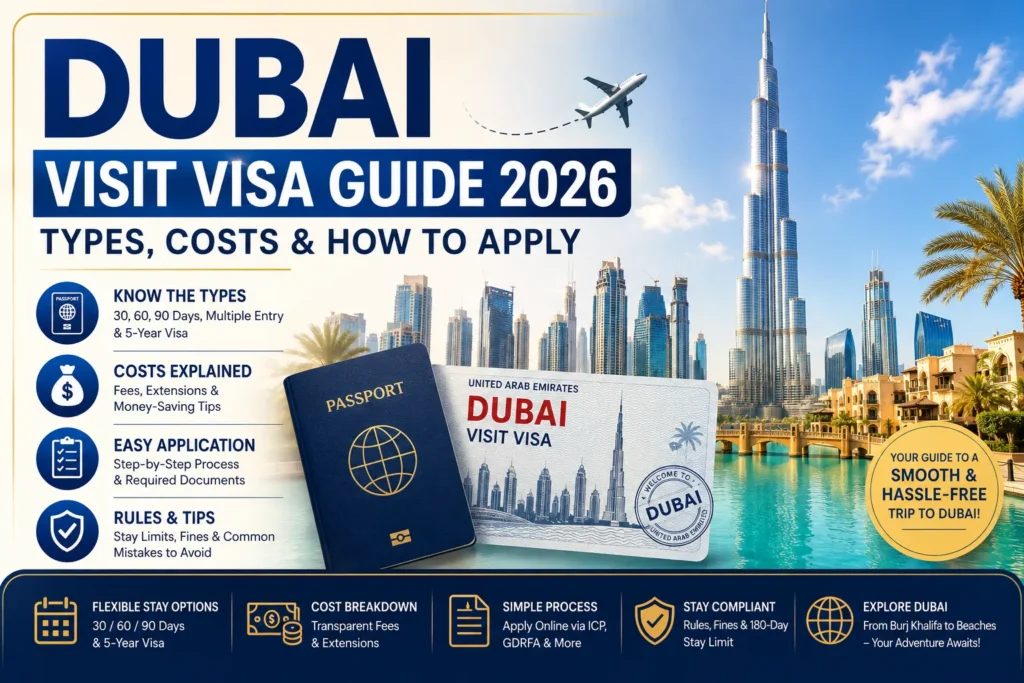
Planning a trip to Dubai? Before you start dreaming about the skyline and the desert safaris, there’s one bit of admin to sort out: your visa. And here’s the thing: the rules changed in 2026, so even if you’ve visited before, some of what you remember is now out of date.The grace period is gone, fines work differently, and you’ve got more stay options than ever.
This Dubai visit visa guide breaks it all down in plain language: who needs one, the different types, what they cost, how to apply, and the mistakes that quietly cost people money. Let’s get you sorted so the only thing you have to worry about is which beach club to hit first.
First: Do You Even Need a Visit Visa?
Not everyone does, and it depends entirely on your passport.
If you’re a citizen of a GCC country Saudi Arabia, Kuwait, Bahrain, Qatar, or Oman you walk in without a visa at all. Lucky you.
A big group of nationalities get a visa on arrival. Passport holders from the US, UK, Canada, Australia, Japan, South Korea, China, and most EU states get a stamp in their passport at the airport. Usually that’s a 30-day entry (often extendable by another 30) or, for some, a 90-day entry. One catch worth knowing: the 90-day visa-on-arrival generally can’t be extended, while many 30-day ones can. Always confirm your specific nationality’s privileges with your airline before flying — these things vary more than you’d expect.
And then there’s everyone else. For many travellers from Asia and Africa, you need to arrange your visit visa before you travel, typically sponsored by a UAE airline, hotel, travel agency, or a relative who’s a UAE resident. If that’s you, don’t leave it to the last minute.
Types of Dubai Visit Visa
The UAE simplified things in a nice way recently: you can now pick the duration that actually fits your trip instead of being stuck with a 30-day default.
30-day visa the classic tourist option. Single or multiple entry. Perfect for a standard holiday. It’s extendable, but as you’ll see below, extending isn’t always the cheapest path.
A 60-day visa is the sweet spot for a lot of people. Great for longer holidays, family visits, or if you’re combining Dubai with Abu Dhabi and the other emirates. Honestly, if there’s any chance you’ll stay more than a month, just get this from the start. More on why in a second.
90-day visa for extended stays. Think long family visits, recovery after medical treatment, or job seekers who want breathing room to explore options without rushing. Curiously, the financial proof for the 90-day can be lower than the 60-day in some cases (around AED 3,000), so it’s worth comparing.
A multiple-entry visa lets you leave and come back as often as you like within the validity window. Built for business travellers hopping between Dubai, Oman, Bahrain, and Saudi. Each individual stay is still capped (usually 30 or 60 days per visit).
A 5-year multiple-entry tourist visa is the long game. Unlimited entries over five years, up to 90 days per stay, extendable to a maximum of 180 days in any calendar year. No UAE sponsor needed. You’ll need to show a decent bank balance (ICP guidance points to around USD 4,000 over the prior six months). If you visit Dubai regularly, this one genuinely pays for itself.
One rule that applies across the board: you can’t stay more than 180 days total in a single calendar year on visit visas. Plan around that.
How Much Does a Dubai Visit Visa Cost?
Let’s talk about money. A quick honesty note first: prices vary by route (government portal vs travel agent), service charges, insurance, and processing speed, so treat these as ballpark 2026 figures and confirm the exact amount before you pay. Roughly, the whole range runs from about AED 250 to AED 1,500 depending on type.
Here’s the practical breakdown:
- 30-day visa: government fee around AED 200 plus VAT, but with service charges the all-in cost is higher. Extendable up to twice (30 days each), giving a maximum stay of 90 days.
- 60-day visa: typically lands somewhere around AED 580–900 all-in. Government fee about AED 300 plus VAT.
- 90-day visa: usually in the AED 900–1,500 range.
Now, the money-saving tip that nobody tells first-timers. If you take a 30-day visa and later extend it, each extension can run AED 680–780. So a 30-day visa plus one extension can total well over AED 1,000 for 60 days of stay more than just buying the 60-day visa upfront. The lesson is simple: if you even suspect you’ll want longer than a month, buy the longer visa from day one. It’s cheaper and far less hassle.
What Documents You’ll Need
The good news is the document list is short and sensible. For most visit visas, have these ready:
- A passport valid for at least six months
- A recent passport-size photo with a plain background
- A confirmed return or onward flight ticket
- Travel insurance (increasingly expected, and just smart anyway)
- Sometimes a hotel booking or proof of where you’re staying
- For longer or 5-year visas, financial proof such as recent bank statements
Double-check spelling and passport numbers on the application. A surprising number of rejections come down to a tiny typo or a mismatched detail completely avoidable, genuinely annoying.
How to Apply, Step by Step
You’ve got a few routes, and they’re all fairly painless in 2026.
- Pick your visa type 30, 60, or 90 days, single or multiple entry, based on your actual plans.
- Gather your documents, passport scan, photo, ticket, insurance.
- Apply through an official channel. The two government portals are ICP (the federal Identity, Citizenship, Customs and Port Security authority) and GDRFA (Dubai’s residency directorate). You can also go through your airline, hotel, or a licensed travel agency.
- Pay the fee and submit.
- Wait for approval it’s usually quick, often 2–5 working days, and some services turn it around in 48 hours.
One word of caution: stick to official portals or genuinely trusted, licensed providers. The visa space attracts scammers, and a “too good to be true” price usually is.
If you need more time in the UAE, you can apply for a Dubai visa extension before your visa expires.
Extending Your Dubai Visit Visa
This is where 2026 made life easier. A few key changes:
You can now extend your visit visa from inside the UAE without doing the old “fly out and fly back in” dance. As of late 2025, you can apply for up to two 30-day extensions online through the ICP portal. That’s a real saving in time, money, and stress.
A 30-day visa can typically be extended twice (taking you to a 90-day maximum). A 60-day visa can usually be extended once. Each extension carries a government fee of around AED 600 plus VAT and any service charge — so budget roughly AED 680–780 per extension.
The golden rule: apply before your current visa expires. Which brings us to the part that trips people up.
Overstaying: Just Don’t
Here’s the big 2026 change, and it’s a strict one. The old 10-day grace period is gone. There is no buffer anymore.
From April 2026, overstay fines are AED 50 per day, charged from day one, and the rate is now uniform across all seven emirates. It adds up fast. Overstay by more than 30 days and you’ll also need an Exit Permit (around AED 250–300) at the airport before you can leave. Repeated overstaying can land you a re-entry ban.
So set a reminder on your phone for a few days before your visa ends. Seriously — it’s the single easiest way to avoid handing money to the immigration desk for nothing.
Can You Work on a Visit Visa?
Short answer: no. And the penalties got serious.
You can absolutely attend interviews, meetings, and business discussions on a visit visa. What you cannot do is start a job or receive payment from a UAE employer until you’ve converted to a proper work or employment visa. Working illegally on a visit visa in 2026 can mean an AED 50,000 fine, deportation, and a labour ban. Not worth it.
If you’re coming specifically to find work, there’s a clean legal route: the Jobseeker Visa, available in 60, 90, or 120-day options, with no employer sponsor required. It’s purpose-built for exactly this, so use it rather than gambling on a tourist visa.
A Few Smart Tips Before You Apply
- Match the visa to the trip. Tourists usually do fine on 30 days. Job seekers and long family visits lean 60 or 90.
- Buy longer upfront if in doubt — extending later often costs more than starting with a longer visa.
- Screenshot your visa and approval and keep a copy in your email and on your phone.
- Diarise the expiry date. No grace period means no second chances.
- Confirm fees on the official ICP or GDRFA site before paying anyone — they can change.
Frequently Asked Questions
How long can I stay in Dubai on a visit visa?
Depending on the visa you choose, 30, 60, or 90 days per visit. With extensions you can stretch a stay further, but your total time in the UAE on visit visas can’t exceed 180 days within a single calendar year.
How much does a Dubai visit visa cost in 2026?
Roughly AED 250 to AED 1,500 depending on the type, route, and service charges. As a rough guide, the 60-day visa often lands around AED 580–900 and the 90-day around AED 900–1,500. Always confirm the current fee on the official portal before paying.
Can I extend my Dubai visit visa without leaving the country?
Yes. As of late 2025 you can apply for up to two 30-day extensions online through the ICP portal without exiting the UAE. Just make sure you apply before your current visa expires — there’s no longer a grace period.
Is there still a grace period after my visa expires?
No. The previous 10-day grace period was removed. From April 2026, overstay fines start at AED 50 per day from the very first day, applied uniformly across all emirates.
Can I work in Dubai on a visit visa?
No. You can attend interviews and meetings, but you can’t legally start work or get paid until you switch to a work visa. If you’re job hunting, apply for the dedicated Jobseeker Visa (60, 90, or 120 days) instead.
Which is better a 30-day visa or a 60-day visa?
If you’re staying a month or less, the 30-day is fine. But if there’s any chance you’ll stay longer, buy the 60-day upfront — extending a 30-day visa usually ends up costing more than the longer visa would have in the first place.
Do I need a sponsor for a Dubai visit visa?
It depends on the type. Standard visit visas are often sponsored by an airline, hotel, travel agency, or a UAE-resident relative. The 5-year multiple-entry tourist visa, however, needs no sponsor — just proof of sufficient funds.
Final Thoughts
The 2026 updates mostly make visiting Dubai easier — longer stay options, online extensions, no more leave-and-return runs. The flip side is that the rules are stricter where it counts: no grace period, daily overstay fines from day one, and real penalties for working on the wrong visa. Respect those and you’re golden.
So pick the visa that genuinely matches your plans, apply through an official channel, keep an eye on that expiry date, and you’ll breeze through. Sort the paperwork once, properly, and the rest of your trip is pure Dubai.
Visa fees, durations, and rules are approximate 2026 figures and change frequently. Always confirm the latest details on the official ICP (icp.gov.ae) or GDRFA (gdrfad.gov.ae) channels before applying or travelling.