Dubai doesn’t slow down. That’s not just a tourism tagline, it’s the reality of a city that’s constantly building, expanding, and reinventing itself. And with that momentum comes a job market that genuinely needs people. The right people, in the right fields.
But here’s what a lot of job seekers get wrong: they come to Dubai chasing “any job” rather than understanding where the real demand is. The difference between those two approaches can mean months of frustration versus landing a role in weeks.
So let’s talk about which demand jobs in Dubai are actually growing right now, what employers are looking for, and what kind of salary you can realistically expect.
Before applying for any of these jobs, create a recruiter-friendly resume using our How to Create a CV for UAE Jobs (2026 Guide).
Why Dubai’s Job Market Keeps Growing
A few things are driving the current hiring boom and they’re worth understanding before diving into the list.
First, Dubai’s population keeps rising. The city crossed 3.7 million residents and it’s still climbing which puts constant pressure on healthcare, education, construction, and services. Second, the UAE government’s economic diversification push (Vision 2031) is deliberately funding tech, finance, and creative industries to reduce dependence on oil. Third, major events and infrastructure projects, new metro lines, Expo City development, tourism expansion — create sustained demand in construction and hospitality.
This isn’t a short-term spike.These are structural shifts that are reshaping which skills Dubai is willing to pay well for.
Top In Demand Jobs in Dubai in 2026
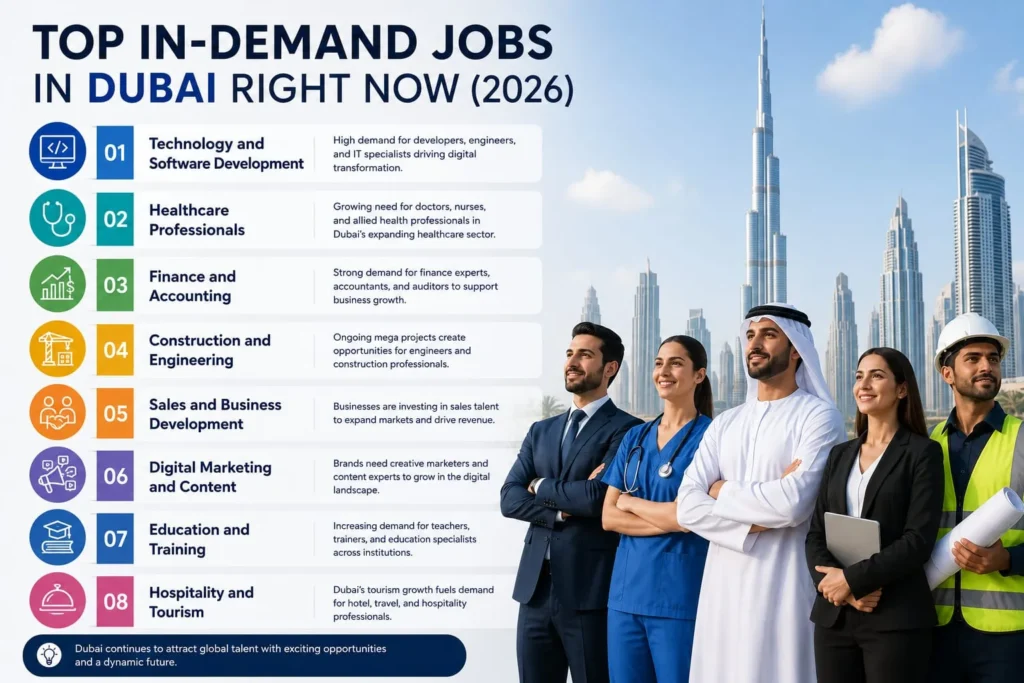
1. Technology and Software Development
This is the biggest one right now. Dubai is aggressively positioning itself as a regional tech hub and the talent gap is enormous. Companies can’t hire engineers, developers, and data professionals fast enough.
What’s hot specifically:
- Software engineers (full-stack, backend, mobile)
- Cybersecurity specialists
- Cloud architects (AWS, Azure, Google Cloud)
- Data scientists and ML engineers
- AI product managers
The demand here isn’t just from tech startups. Banks, government entities, real estate companies, and retail giants are all digitizing and they all need technical talent. A mid-level software engineer with 4–5 years of experience can realistically command AED 18,000–28,000 per month. Senior roles go considerably higher.
Practical note: If you’re a developer, Dubai Free Zones like Dubai Internet City (DIC) and Dubai Silicon Oasis (DSO) are where most tech employers cluster. Target companies based there first.
2. Healthcare Professionals
Healthcare is the one sector in Dubai that has been in a near-constant hiring state for the past several years. The city’s healthcare infrastructure expanded massively — and it still needs more people to run it.
Roles in highest demand:
- Registered nurses (especially ICU, ER, and surgical specialties)
- General practitioners and family medicine doctors
- Physiotherapists and occupational therapists
- Radiologists and imaging technicians
- Mental health professionals (still relatively underserved)
What makes healthcare unique in Dubai is that you need licensing from either the Dubai Health Authority (DHA) or the Health Authority Abu Dhabi (HAAD) before you can practice. That process takes time sometimes 2–4 months so factor it into your timeline if you’re moving from abroad.
Salaries for nurses typically range from AED 8,000–16,000 depending on specialization and experience. Doctors earn significantly more, often AED 25,000–60,000 depending on specialty and the type of facility.
3. Finance and Accounting
The Dubai International Financial Centre (DIFC) is one of the world’s top financial hubs. It houses hundreds of banks, asset managers, insurance firms, and fintech companies — and they’re all hiring.
Most in-demand roles:
- Financial analysts and investment professionals
- Risk and compliance officers (especially with FATF/AML knowledge)
- Chartered accountants (ACCA, CPA, CMA holders have a clear edge)
- Corporate finance managers
- Fintech product specialists
Compliance and risk roles deserve special mention because UAE regulatory standards have tightened significantly in recent years. Companies are under real pressure to hire qualified compliance professionals and the market for those skills is tight.
A qualified chartered accountant with 5+ years can expect AED 15,000–25,000. Investment professionals and fund managers at established firms often earn considerably more, particularly with bonus structures.
4. Construction and Engineering
Dubai never really stops building. The skyline is constantly changing, new districts keep emerging, and infrastructure projects run on decade-long timelines. As long as that’s true — and there’s no sign of it stopping — construction and engineering will remain among the most consistent demand jobs in Dubai.
What employers are actively looking for:
- Civil and structural engineers
- Project managers (PMP certified preferred)
- MEP engineers (mechanical, electrical, plumbing)
- Quantity surveyors
- BIM (Building Information Modeling) specialists
BIM is worth highlighting on its own. It’s becoming mandatory on major projects in the UAE and there’s a real shortage of engineers who know the software well. If you’re a civil or structural engineer and you don’t know Revit or Navisworks yet — that’s worth learning.
Salaries range from AED 10,000 for junior engineers to AED 30,000+ for experienced project managers on large-scale developments.
5. Sales and Business Development
Every company in Dubai — from a small trading firm in Deira to a multinational in Business Bay needs people who can sell. And not just sell locally. Dubai is a regional hub, so salespeople who can work across GCC markets are especially valuable.
High-demand sales roles:
- B2B sales managers
- Real estate agents and brokers
- Key account managers
- Business development executives
- SaaS sales specialists
Real estate deserves its own mention. Dubai’s property market has been on a significant upswing and RERA-certified real estate agents with the right network are earning very well — often through commission structures that far exceed base salaries.
Base salaries in sales vary widely, but good performers in real estate or B2B tech sales can realistically earn AED 20,000–50,000/month including commission. The upside is real, but so is the pressure.
6. Digital Marketing and Content
As businesses across the UAE invest more in their online presence, the demand for skilled digital marketers has quietly become one of the strongest in the market. “Digital marketing” is a broad term though what’s actually in demand is more specific.
Skills that are genuinely hard to find:
- Performance marketing (Google Ads, Meta Ads with actual ROAS results to show)
- SEO specialists who understand both technical and content SEO
- Social media managers fluent in Arabic and English
- Video content creators and editors (short-form, especially)
- Marketing analytics professionals
Bilingual marketers Arabic and English command a premium in Dubai because so many brands are trying to reach both expat and local audiences simultaneously. If that’s you, lean into it.
Salaries range from AED 8,000 for junior roles to AED 20,000+ for experienced performance marketers or heads of digital at larger companies.
7. Education and Training
Dubai’s private education sector is booming. With a growing expat population, demand for quality international schools, tutoring centers, and corporate training keeps rising year on year.
What’s being hired:
- Teachers with IB, British, or American curriculum experience
- STEM teachers (science, technology, engineering, maths) — particularly short supply
- Special needs educators and learning support staff
- Corporate trainers and L&D specialists
- University lecturers for private institutions
Most teaching roles come with housing allowance, annual flights, and health insurance — which makes the compensation package more attractive than the base salary alone suggests. A British-curriculum teacher with 3+ years of experience typically earns AED 10,000–18,000 plus benefits.
8. Hospitality and Tourism
Tourism is one of Dubai’s core industries and it’s not slowing down. Dubai welcomed over 17 million international visitors in 2023 and the government’s target is significantly higher by 2030. That growth needs people.
Roles in demand:
- Hotel managers and department heads
- F&B managers and executive chefs
- Front office and guest relations staff
- Event coordinators and MICE professionals
- Travel and tour operations managers
Entry-level hospitality roles are more competitive and salaries are lower — but experienced managers and department heads at luxury properties can earn AED 15,000–30,000 with excellent additional benefits.
Which Field Should You Target?
Here’s a straight answer: go where your skills genuinely fit, not where the list looks impressive. Dubai rewards expertise. A mediocre applicant in a “hot” sector will struggle far more than a strong applicant in a quieter one.
That said, if you’re early in your career and building skills — tech, healthcare, and finance offer the clearest paths to long-term growth and strong salaries in the UAE market.
Salary Quick Reference
| Field | Junior (AED/month) | Mid-Level (AED/month) | Senior (AED/month) |
|---|---|---|---|
| Tech / Software | 10,000–14,000 | 18,000–28,000 | 30,000–50,000+ |
| Healthcare | 8,000–12,000 | 14,000–22,000 | 25,000–60,000 |
| Finance | 8,000–12,000 | 15,000–25,000 | 28,000–50,000+ |
| Construction | 8,000–12,000 | 14,000–22,000 | 25,000–40,000 |
| Sales | 6,000–10,000 | 12,000–20,000 | 20,000–50,000+ |
| Digital Marketing | 6,000–9,000 | 10,000–16,000 | 18,000–28,000 |
| Education | 8,000–12,000 | 10,000–18,000 | 16,000–25,000 |
| Hospitality | 4,000–7,000 | 10,000–16,000 | 15,000–30,000 |
All figures are tax-free. Packages often include health insurance and housing allowance.
Want to know how much these jobs pay? See our detailed guide on Average Salaries in Dubai by Profession (2026 Guide).
FAQ: In-Demand Jobs in Dubai
Q: Which job is easiest to get in Dubai as a foreigner?
Hospitality, retail, and customer service roles are generally more accessible for newcomers with limited UAE experience. Teaching is also relatively straightforward if you have the right curriculum background and certifications. Tech roles are competitive but fast-moving — a strong portfolio can outweigh local experience.
Q: Is Dubai good for fresh graduates in 2026?
It can be, but it takes more strategy. Fresh graduates do well targeting graduate programs at large companies (Emirates, Majid Al Futtaim, HSBC UAE), or entry-level roles in growing sectors like tech and digital marketing. Coming with a specialized skill — even self-taught — is more important than ever.
Q: Do I need Arabic to work in Dubai?
For most expat-facing professional roles — no. English is the dominant working language in corporate Dubai. That said, Arabic is a genuine advantage in roles that involve local client relationships, government dealings, or marketing to Emirati audiences.
Q: Which Dubai free zone is best for job seekers?
It depends on your industry. Dubai Internet City (DIC) for tech, DIFC for finance, Dubai Healthcare City (DHCC) for healthcare, Dubai Media City (DMC) for marketing and media. These zones cluster employers in the same sector, which makes networking and job searching far more efficient.
Q: How long does it realistically take to find a job in Dubai?
For mid-to-senior professionals with in-demand skills, 4–8 weeks is common with a focused approach. For junior candidates or those in less in-demand fields, 2–4 months is more realistic. Being on the ground in Dubai typically shortens the timeline significantly.
Q: What qualifications does Dubai value most?
Internationally recognized certifications carry real weight ACCA or CPA for finance, PMP for project management, AWS or Azure certifications for cloud roles, DHA/HAAD licensing for healthcare. A degree from a recognized university is the baseline expectation for most professional roles.
Final Thoughts
Dubai’s job market in 2026 is genuinely full of opportunity but it rewards people who come prepared and targeted, not those who arrive hoping something will work out. The demand jobs in Dubai right now are concentrated in tech, healthcare, finance, construction, and a few other key sectors. If your background overlaps with any of these, you’re in a strong position.
Do your homework on the specific companies you want to work for. Get your documents and certifications in order before you start applying. And don’t underestimate the power of being in the city. A lot of hiring in Dubai still happens through relationships and being in the right room at the right time.
The opportunity is real. So is the competition. The difference is usually preparation.
You can find openings for these roles through the Best Job Websites in UAE to Find Work Fast (2026).