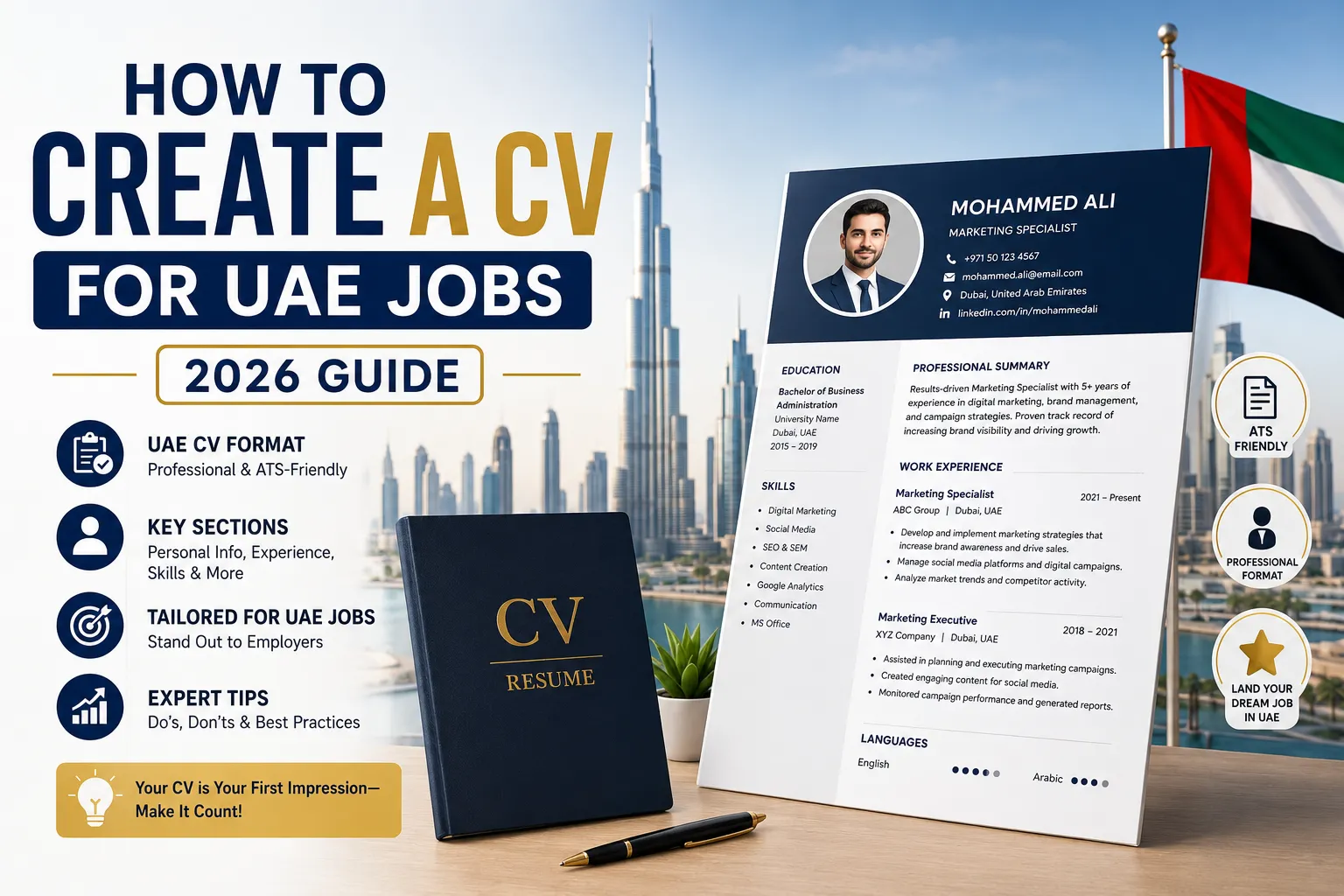
Here’s an uncomfortable truth: your CV probably gets about six to ten seconds before a recruiter in Dubai decides whether to keep reading or move on. And before a human even sees it, software often screens it first. So if you’re sending the same CV you used back home and wondering why nobody’s calling, the problem usually isn’t your experience. It’s the format.
The good news? UAE CV rules are pretty consistent once you know them. This Dubai CV guide walks you through exactly what local employers expect in 2026 the right structure, what goes in your header, and the small details that quietly make or break your application. Let’s build something that actually gets shortlisted.
Before creating your CV, it’s worth understanding which careers are currently hiring. Check our guide on Top In-Demand Jobs in Dubai Right Now (2026).
What Makes a UAE CV Different
If you’ve worked in the US, UK, India, or the Philippines, your instinct is to reuse what worked there. Don’t. A UAE CV carries a few things a Western résumé never would.
The big one is your visa status. In most countries, employers assume you’re authorized to work. In the UAE, your visa situation directly affects hiring timelines and sponsorship, so recruiters screen for it early. Leaving it off is one of the fastest ways to get skipped.
You’ll also typically include your nationality and availability (more on both shortly). These aren’t nosy questions they’re practical screening signals in a market where most candidates are expats. The sooner a recruiter sees them, the easier their decision.
Everything else work history, education, skills follows familiar logic. It’s the local layer on top that trips people up.
The Right UAE CV Format
Let’s settle the format question first, because it matters more than people think.
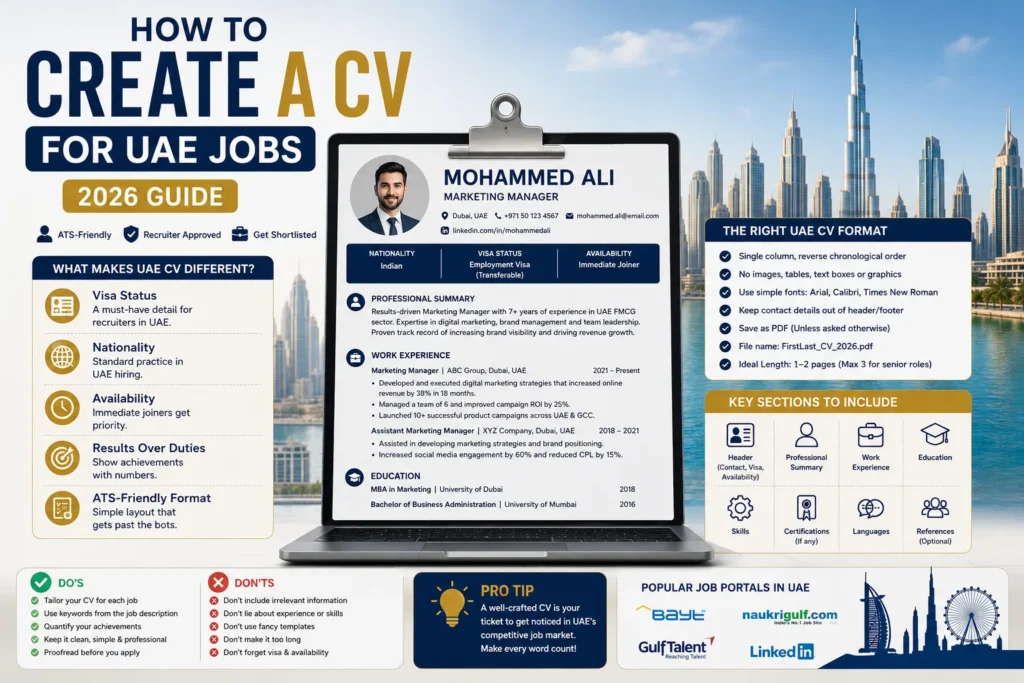
Use a single-column, reverse-chronological layout. Most recent role at the top, working backwards. That’s it. The fancy two-column templates with sidebars, icons, and skill bars? They look lovely and they break applicant tracking systems (ATS) on Bayt, GulfTalent, NaukriGulf, and corporate platforms like Workday and Taleo. The software reads left to right, and columns scramble that. A gorgeous CV that the system can’t parse is worse than a plain one it can.
A few hard rules worth memorizing:
- No text boxes, tables, or graphics in the body. ATS parsers choke on them.
- Standard fonts only Arial, Calibri, or Times New Roman. Save the creativity for your portfolio.
- Keep contact details out of the header/footer of the Word file. Many parsers ignore those zones entirely, so your phone number can vanish.
- Save as PDF unless the job ad specifically asks for Word. And name the file properly: FirstLast_CV_2026.pdf, not final_final_v3.pdf. For government portals, keep it under 300 KB.
On length, keep it tight. One page if you’re a fresh graduate, two pages once you’ve got five-plus years behind you, and three only if you’re senior executive, medical, or academic with publications to show. Honestly, a focused two-page CV beats a padded three-pager every single time. Recruiters notice padding instantly.
What to Put in Your Header
Your header is the first thing the ATS reads and the first thing a recruiter’s eye lands on. Get it right and the rest of the CV gets a fair shot.
Line one: your full name, slightly larger than the body text.
Below that, a clean line with your location (Dubai, UAE / Abu Dhabi, UAE), UAE phone number with +971, a professional email, and your LinkedIn URL if it’s current.
Then a second line carrying the UAE-specific stuff:
- Nationality — your passport nationality.
- Visa status — be specific. Employment Visa (and whether it’s transferable), Golden Visa, Spouse/Dependent Visa, or Visit Visa. If you’re on an employment visa, noting it’s transferable is a plus.
- Availability — “Immediate joiner” is gold in this market. If you’re serving notice, state the period (30 days, 60 days). Employers genuinely favour people who can start sooner.
You can also add a target role that mirrors the job title in the posting. Small touch, real impact.
One quick example of a clean header line:
Dubai, UAE | +971 50 XXX XXXX | yourname@email.com | linkedin.com/in/yourname Nationality: Indian | Visa: Employment Visa (Transferable) | Availability: 30 days
That’s everything a recruiter needs to make a fast yes.
Writing a Professional Summary That Works
Skip the objective statement. “Seeking a challenging role where I can grow my skills” tells a recruiter nothing and signals that you’ve reused a template. They’ve read that exact line a thousand times.
Instead, write three or four sentences of evidence. Who are you professionally, how many years and in which sector, one or two quantified wins, and what you’re targeting. If you have UAE or GCC experience, say so right here it’s a strong signal that you understand the local market.
Compare these two:
Weak: “Hardworking marketing professional looking for a good opportunity in Dubai.”
Strong: “Marketing manager with 7 years in UAE FMCG, specialising in digital campaigns. Grew online revenue 38% in 18 months at a Dubai-based retailer. Looking to lead brand strategy for a mid-size consumer business in the Gulf.”
The second one earns the next ten seconds. The first one gets deleted.
Your Work Experience: Show Results, Not Duties
This is where most CVs quietly fail. People copy-paste their job description and list responsibilities. “Responsible for sales.” “Handled customer queries.” Recruiters don’t care what you were supposed to do they care what you actually achieved.
So quantify. Every bullet should ideally follow a simple shape: action verb + what you did + the result, with a number attached.
- Weak: “Responsible for improving the sales process.”
- Strong: “Grew B2B revenue from AED 2M to AED 3.4M in 18 months by restructuring the sales pipeline.”
Numbers do the persuading for you. Percentages, dirham figures, time saved, headcount managed, targets beaten whatever’s true for your role. And put each company’s location next to its name (Dubai, UAE), so your Gulf experience is impossible to miss.
Keep dates clean and consistent (MM/YYYY – MM/YYYY) with no unexplained gaps. UAE recruiters scan tenure closely.
Skills, Education, and Certifications
Your skills section should be a tight, scannable list of real tools and competencies and here’s the trick: pull the exact terms from the job ad. If they want “Salesforce,” don’t write “CRM software.” Name the platform. SAP, Power BI, AutoCAD, UAE VAT, Tally the specific nouns are what ATS systems match on.
For education, list your highest qualification first. Degree, institution, year. If you graduated recently and your GPA was strong, you can include it. Note: if your degree needs attestation for certain roles, that’s a separate process — but don’t staple certificates to your CV.
Certifications carry real weight in the UAE, where employers value continuous learning. List relevant courses and professional credentials. And don’t underestimate languages in this multicultural market they’re a genuine differentiator. English is essential; Arabic is a strong plus, especially for government or Abu Dhabi roles.
Should You Add a Photo?
Ah, the photo debate. Honestly, opinions differ even among recruiters, so here’s the straight version.
A photo is optional for most private-sector roles in 2026. For customer-facing jobs sales, hospitality, reception, some HR roles it’s more common and can help. For technical, finance, and back-office positions, it’s usually unnecessary and occasionally just clutters the layout. Some mainland and semi-government employers still expect one; many multinationals don’t.
My honest take: if you include one, make it a proper professional headshot on a plain background. No selfies, no holiday crops, no busy backgrounds. And insert it as a simple inline image, never inside a table or text box (that breaks ATS parsing again). If the role is back-office and the ad doesn’t ask for a photo, you lose nothing by leaving it off.
What you should definitely drop in 2026: religion, height, weight, and full passport numbers. These showed up on older Gulf CVs but now read as dated. Marital status and date of birth are optional — increasingly left off, and that’s fine.
Beating the ATS
Since software screens first, you want to feed it the right keywords naturally, not stuffed.
Before you edit, pull ten to fifteen phrases straight from the job description and weave the relevant ones into your summary, skills, and bullets. Focus on nouns and tools rather than buzzwords: “invoice processing,” “reconciliation,” “client onboarding,” “preventive maintenance,” “stakeholder management,” “UAE VAT,” “CRM (Salesforce).” Only include what’s genuinely true for you, obviously keyword-stuffing things you can’t back up in an interview is a bad trade.
The principle is simple: a CV that mirrors the job ad’s language ranks higher, reaches more human eyes, and gets you closer to an interview.
Common Mistakes to Avoid
A few patterns sink good candidates again and again:
- Sending one generic CV to every job. Tailor the summary and skills each time. It takes ten minutes and it works.
- Two-column or graphic-heavy templates. Pretty, but ATS-fatal.
- Missing visa status and availability. Instant screening blocker in the UAE.
- Listing duties instead of achievements. No numbers, no impact, no callback.
- Typos and a wrong phone number. Proofread twice. Then check the number again you’d be amazed how often it’s a digit off.
- Attaching passport copies and certificates to the application. In the UAE this isn’t expected and can actually put employers off. They’ll ask if they need them.
A Quick Pre-Submit Checklist
Before you hit send, run a thirty-second check:
- Single column, reverse-chronological, clean fonts ✓
- Header has location, +971 number, email, LinkedIn, nationality, visa status, availability ✓
- Summary is specific and quantified, not a generic objective ✓
- Experience shows results with numbers ✓
- Keywords mirror the job ad ✓
- 1–2 pages (3 max for senior roles) ✓
- Saved as PDF, sensible file name, under 300 KB for portals ✓
- Proofread twice ✓
Tick all of those and you’re already ahead of most of the pile.
Frequently Asked Questions
What is the best CV format for UAE jobs in 2026?
A single-column, reverse-chronological layout saved as a PDF. Avoid two-column templates, tables, text boxes, and graphics — they break the applicant tracking systems used across Bayt, GulfTalent, and corporate portals. Clean structure beats fancy design every time.
If you’re applying from outside the UAE, read our guide on How to Find a Job in Dubai as a Foreigner.
Do I need to include my visa status on a UAE CV?
Yes — and prominently, near the top. Visa status (and your availability or notice period) directly affects hiring timelines and sponsorship, so UAE recruiters screen for it before reading your experience. Leaving it off is a common reason qualified candidates get filtered out.
How long should a UAE CV be?
One page for fresh graduates, two pages for professionals with five or more years of experience, and up to three pages only for senior executives or medical and academic roles. Anything longer rarely gets read in full.
Should I put a photo on my UAE CV?
It’s optional for most private-sector roles in 2026. A photo is more common for customer-facing jobs (sales, hospitality, reception) and less necessary for technical, finance, or back-office positions. If you include one, use a professional headshot on a plain background, inserted as a simple inline image.
Can I get a job in Dubai without UAE experience?
Yes. Many employers especially in tech, healthcare, engineering, hospitality, and finance hire from abroad. If you don’t have local experience, lead with transferable skills, international exposure, and quantified achievements, and make your availability clear.
Should I list salary expectations on my CV?
No, not unless the job posting specifically asks for it. Compensation is normally discussed during the interview stage, so keep it off the document.
Final Thoughts
A strong UAE CV isn’t about cramming in more it’s about giving recruiters exactly what they’re scanning for, fast. Get the format clean, lead with your visa status and availability, swap duties for quantified results, and mirror the job ad’s language so the software lets you through. None of that requires new qualifications. It’s just better packaging of what you already bring.
So don’t fire off the same file to twenty jobs and hope. Build one solid UAE-tuned template, tailor the top of it for each role, and apply with intention. That single shift from generic to targeted is usually the difference between silence and a phone that finally rings.
Once your CV is ready, you can start applying through the Best Job Websites in UAE to Find Work Fast