If you are searching for cheap areas in Dubai to rent as an expat, you are in the right place. Dubai has a reputation for being expensive and in some neighbourhoods, that reputation is completely justified. But the city also has genuinely cheap areas in Dubai where working professionals and families live comfortably without stretching their budgets. The difference between choosing a cheap area in Dubai versus a premium one can be AED 60,000 or more per year real money that goes straight into your savings. ExploreDubaiLife.com | Your Honest Guide to Life in the UAE
Choosing affordable communities can reduce your overall Cost of Living in Dubai.
Quick Comparison: Cheapest Areas in Dubai at a Glance
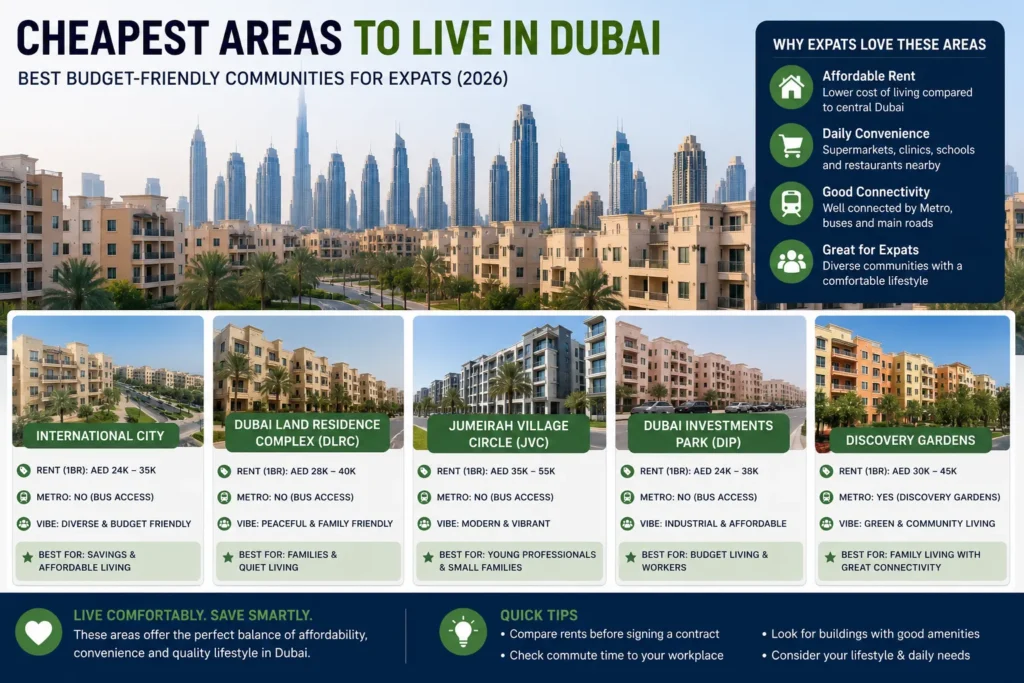
Before going into detail on each area, here is a side-by-side summary of rent ranges across all eight neighbourhoods:
Compare current Rent Prices in Dubai before signing a lease
| Area | Studio (AED/yr) | 1-Bedroom (AED/yr) | Metro Access | Best For |
| International City | 30,000 – 41,000 | 44,000 – 68,000 | Nearby bus links | Budget expats, students |
| Al Nahda | 32,000 – 48,000 | 50,000 – 75,000 | Al Nahda Metro | Professionals, families |
| Deira | 28,000 – 45,000 | 48,000 – 72,000 | Multiple stations | Central location seekers |
| Discovery Gardens | 33,000 – 50,000 | 52,000 – 78,000 | Discovery Gardens Metro | Quiet lifestyle, families |
| Dubai Silicon Oasis | 35,000 – 52,000 | 55,000 – 82,000 | Bus + RTA links | Tech workers, families |
| Jumeirah Village Circle | 40,000 – 58,000 | 65,000 – 95,000 | Limited, improving | Young professionals |
| Al Quoz | 28,000 – 44,000 | 45,000 – 70,000 | Mall of Emirates Metro | Artists, blue-collar workers |
| Dubai South | 30,000 – 46,000 | 48,000 – 74,000 | Route 2020 Metro | Airport staff, new expats |
1. International City Dubai’s Most Affordable Address
If there is one area in Dubai that delivers the most housing for the least money, it is International City. Built across 800 hectares in the Al Warsan district, this sprawling community is divided into themed clusters named after countries China, Spain, Persia, England, Italy, and more each with its own architectural character.
The numbers speak for themselves: a studio here typically rents for AED 30,000 to AED 41,000 per year, while a one-bedroom apartment runs AED 44,000 to AED 68,000 annually. Compare that to similar-sized units in Business Bay or Dubai Marina, and you are looking at savings of AED 40,000 to AED 80,000 every year.
Who Lives Here?
International City attracts a genuinely diverse mix of residents — university students from nearby Academic City, newly arrived expats getting their footing in the city, budget-conscious professionals on mid-range salaries, and families who want more space without stretching their finances.
Pros and Cons
- Pros: Lowest rents in Dubai, 120,000+ residents creating a real community, Dragon Mart shopping nearby, multiple dining and grocery options within each cluster
- Cons: No direct Metro line (bus-dependent), distance from major business hubs like DIFC and Downtown, older building stock in some clusters
| Property Type | Annual Rent (AED) | Monthly Estimate (AED) |
| Shared Room | 14,000 – 24,000 | 1,200 – 2,000 |
| Studio Apartment | 30,000 – 41,000 | 2,500 – 3,400 |
| 1-Bedroom Apartment | 44,000 – 68,000 | 3,700 – 5,700 |
2. Al Nahda Affordable Living With Metro Access
Al Nahda sits right at the Dubai-Sharjah border, and that position is both its biggest advantage and its one genuine drawback. On the plus side, it sits on the Metro’s Green Line, making it one of the most well-connected affordable areas in the city. On the downside, if you work in Sharjah and commute during peak hours, the traffic on that border crossing can test your patience.
For most Dubai-based expats, though, Al Nahda is a genuinely strong option. Rents for studios fall in the AED 32,000–48,000 per year range, and the area has good supermarkets, clinics, pharmacies, and a solid selection of restaurants — including a strong South Asian food scene that many expats find reassuring when they first arrive.
Pros and Cons
- Pros: Al Nahda Metro station (Green Line), well-developed infrastructure, popular with South Asian and Arab expats, competitive rents vs. quality ratio
- Cons: Heavy traffic toward Sharjah border, older building stock, limited green spaces
3. Deira Old Dubai, Low Prices, Real Character
Deira is where Dubai began, and in many ways it is still the most authentically urban part of the city. It is dense, diverse, and full of life in a way that the newer master-planned communities simply cannot replicate. The Gold Souk, Spice Souk, and Dubai Creek are all here — and so are some of the lowest apartment rents in the emirate.
Studios in Deira can be found from AED 28,000 per year, making it the most affordable area in this guide on a pure rent basis. The trade-off is that the building stock is older, and you will not get the modern gym-pool-parking package that newer developments offer. What you get instead is excellent Metro access (several stations on both the Red and Green lines), proximity to the airport, and a neighbourhood that buzzes with real commercial and social energy.
Pros and Cons
- Pros: Lowest rent options in Dubai, multiple Metro stations, close to Dubai International Airport, vibrant market culture, strong sense of community
- Cons: Older buildings, more congested streets, not ideal for those wanting quiet residential environments
4. Discovery Gardens Green, Quiet, and Well-Connected
Discovery Gardens occupies an interesting position in Dubai’s affordable housing market. It is genuinely attractive with lots of greenery, well-maintained communal areas, and a community layout that makes it feel less like a concrete jungle and more like a place where people actually live. It is also on the Metro’s Red Line, with its own dedicated Discovery Gardens station.
It is particularly popular with Indian and Pakistani expat families who appreciate the quieter environment and the proximity to Ibn Battuta Mall for shopping and weekend activities. Rents for studios run AED 33,000–50,000 per year, and one-bedroom apartments are typically AED 52,000–78,000.
Pros and Cons
- Pros: Discovery Gardens Metro station (Red Line), peaceful residential atmosphere, good greenery and communal spaces, close to Ibn Battuta Mall and JBR beach
- Cons: Slightly higher rents than International City or Deira, limited dining variety within the area itself
5. Dubai Silicon Oasis Affordable and Tech-Forward
Dubai Silicon Oasis (DSO) was purpose-built as a technology hub, and that heritage shows. The community is well-planned, clean, and surprisingly green for a Dubai suburb. It hosts over 1,000 registered tech companies, which means a steady professional population and a good standard of shared amenities parks, retail, schools, and cafes.
For expats working in the technology or business sector, DSO offers something valuable beyond just affordable rent: the ability to potentially live close to your workplace. Studio apartments here run AED 35,000–52,000 annually, and the community has a noticeably higher standard of building quality compared to older areas like Deira or parts of International City.
Pros and Cons
- Pros: Modern, well-planned community, good schools and family infrastructure, strong tech employment cluster, relatively new building stock
- Cons: No Metro station (bus and private transport dependent), slightly farther from central Dubai hubs
6. Jumeirah Village Circle (JVC) The Young Professional’s Sweet Spot
JVC sits at a slightly higher price point than the other areas on this list, but it earns its place here for one reason: the value-for-money ratio is exceptional. You get modern apartments with good finishes, a growing selection of cafes and restaurants, and a community that feels genuinely alive, all for rents that are still 30–40% below what you would pay in Dubai Marina or Downtown.
Studios in JVC typically run AED 40,000–58,000 per year, and the community has been developing rapidly. The Metro connectivity is limited currently, but improving infrastructure and the sheer volume of new residents moving in each year suggests this will change.
Pros and Cons
- Pros: Modern apartments, growing community with good dining and retail, competitive rents vs. quality, popular with young expat professionals
- Cons: Limited Metro access currently, heavy road traffic during peak hours, still developing in some areas
7. Al Quoz Dubai’s Hidden Affordable Neighbourhood
Al Quoz rarely makes it onto affordable Dubai living guides, and that is genuinely surprising given what it offers. Situated in central Dubai right behind Mall of the Emirates one of the city’s best Metro stations, Al Quoz combines very low rents with surprisingly good connectivity.
The area is a mix of industrial warehouses and residential buildings, which gives it a grittier feel than Discovery Gardens or JVC. But for those who can look past the aesthetics, studios from AED 28,000 per year and easy Metro access make it one of the best-kept budget secrets in Dubai.
Pros and Cons
- Pros: Very low rents, Mall of Emirates Metro station nearby (Red Line), central location in Dubai, some areas have an arts and creative community vibe
- Cons: Mixed industrial and residential zoning creates a less polished environment, fewer dedicated community amenities
8. Dubai South Emerging, Affordable, and Airport-Adjacent
Dubai South is the newest entry on this list and arguably the most interesting for expats arriving in 2026. Built around Al Maktoum International Airport and anchored by Expo City Dubai, it is a purpose-built community that is still in the early stages of development which means rents are significantly below where they will likely be in five years.
Studio apartments here run 40–60% below prices in Dubai Marina, typically in the AED 30,000–46,000 per year range. The Route 2020 Metro extension connects it to the rest of the city, and for expats working in logistics, aviation, or at Expo City, it offers the rare benefit of a genuinely short commute.
Pros and Cons
- Pros: Very affordable rents, Route 2020 Metro access, modern new-build apartments, great for aviation and logistics industry workers
- Cons: Still developing limited retail and dining options for now, some distance from central Dubai entertainment and nightlife
How to Choose the Right Area for You
After reviewing all eight options, the right choice comes down to three personal priorities. Here is a simple framework to help you decide:
| Your Priority | Best Area to Consider |
| Absolute lowest rent possible | International City, Deira, or Al Quoz |
| Good Metro connectivity + affordability | Al Nahda, Discovery Gardens, or Al Quoz |
| Modern apartments + community feel | JVC or Dubai Silicon Oasis |
| Close to airport / aviation work | Dubai South or Deira |
| Quiet family environment | Discovery Gardens or Dubai Silicon Oasis |
| Young professional lifestyle | JVC or Dubai Silicon Oasis |
Practical Tips Before You Sign a Lease in Dubai
- Always visiting the area in person before signing photos on property portals rarely tell the full story about noise levels, traffic, or building condition.
- Negotiate your rent Dubai law requires landlords to give 90 days notice before increasing rent, and many landlords will negotiate to avoid vacancy.
- Check the RERA rental calculator (smartservices.rera.gov.ae) to verify whether your quoted rent is within the legal increase range.
- Ask about chiller fees (district cooling) separately in some buildings, this is a major hidden cost not included in the advertised rent.
- Consider the Ejari registration cost (around AED 220) when budgeting it is a mandatory legal requirement for all Dubai tenancy contracts.
- Factor in your commute before deciding affordable rent quickly loses its appeal if you are spending AED 600/month on taxis because there is no Metro nearby.
More Resources from ExploreDubaiLife.com
If you found this guide useful, you might also want to read:
- Monthly Expenses in Dubai: Complete Breakdown (2026) exploredubailife.com/monthly-expenses-dubai
- Cost of Living in Dubai for a Single Person exploredubailife.com/cost-of-living-in-dubai-for-a-single-person
- How to Find a Job in Dubai as an Expat — Coming Soon
- Best Areas in Dubai for Families — Coming Soon
Frequently Asked Questions
Q1: What is the cheapest area to live in Dubai for expats?
International City and Deira consistently offer the lowest rents in Dubai for expats. Studios in International City are available from AED 30,000 per year, while Deira offers options from AED 28,000 per year. Both have the trade-off of older building stock and limited Metro access in International City’s case.
Q2: Can I live in Dubai on a salary of AED 5,000 per month?
Yes, it is possible but it requires careful planning. In areas like International City or Deira, a studio apartment costs around AED 2,500–3,000 per month, leaving AED 2,000–2,500 for food, transport, and utilities. Shared accommodation reduces costs further. It is a tight budget but liveable with discipline.
Q3: Which cheap Dubai area has the best Metro access?
Al Nahda (Green Line), Discovery Gardens (Red Line), and Al Quoz near Mall of the Emirates (Red Line) offer the best Metro connectivity among the affordable areas. Deira has multiple stations on both lines, making it the most Metro-connected affordable neighbourhood overall.
Q4: Are cheap areas in Dubai safe for expats?
Yes. Dubai consistently ranks as one of the safest cities in the world, and this extends to all residential neighbourhoods including the more affordable ones. Budget areas like International City, Al Nahda, and Deira are home to hundreds of thousands of expat residents and are generally very safe for daily life.
Q5: How do rent prices in Dubai’s cheap areas compare to Sharjah?
Sharjah is generally 20–30% cheaper than Dubai’s budget areas for comparable apartments. However, the trade-off is a potentially difficult daily commute especially during peak hours on the Dubai-Sharjah border road. Many expats find that the time cost of that commute makes Dubai’s affordable areas a better practical choice overall.
Q6: Can I find furnished apartments in Dubai’s cheap areas?
Yes, furnished apartments are available in all eight areas covered in this guide, typically at a 15–25% premium over unfurnished units. International City and JVC in particular have a good supply of furnished studios and one-bedroom apartments aimed at newly arrived expats.
Final Thoughts
Dubai does not have to be expensive. The city is full of affordable, well-functioning neighbourhoods where hundreds of thousands of expats live comfortably without sacrificing safety, infrastructure, or quality of life.
The key insight from this guide is simple: the further you move from the Marina-Downtown-DIFC triangle, the more your money stretches. International City and Deira are at one end of that spectrum; JVC and Dubai Silicon Oasis are at the other slightly pricier, but with more modern amenities and a stronger community feel.
Whichever area you choose, visit it in person before you commit. Walk the streets, check the commute to your workplace, grab a meal at a local restaurant, and get a feel for the daily rhythm. No guide including this one can replace the knowledge you gain from spending a few hours actually being there.
Good luck with your move. Dubai rewards those who do their homework.