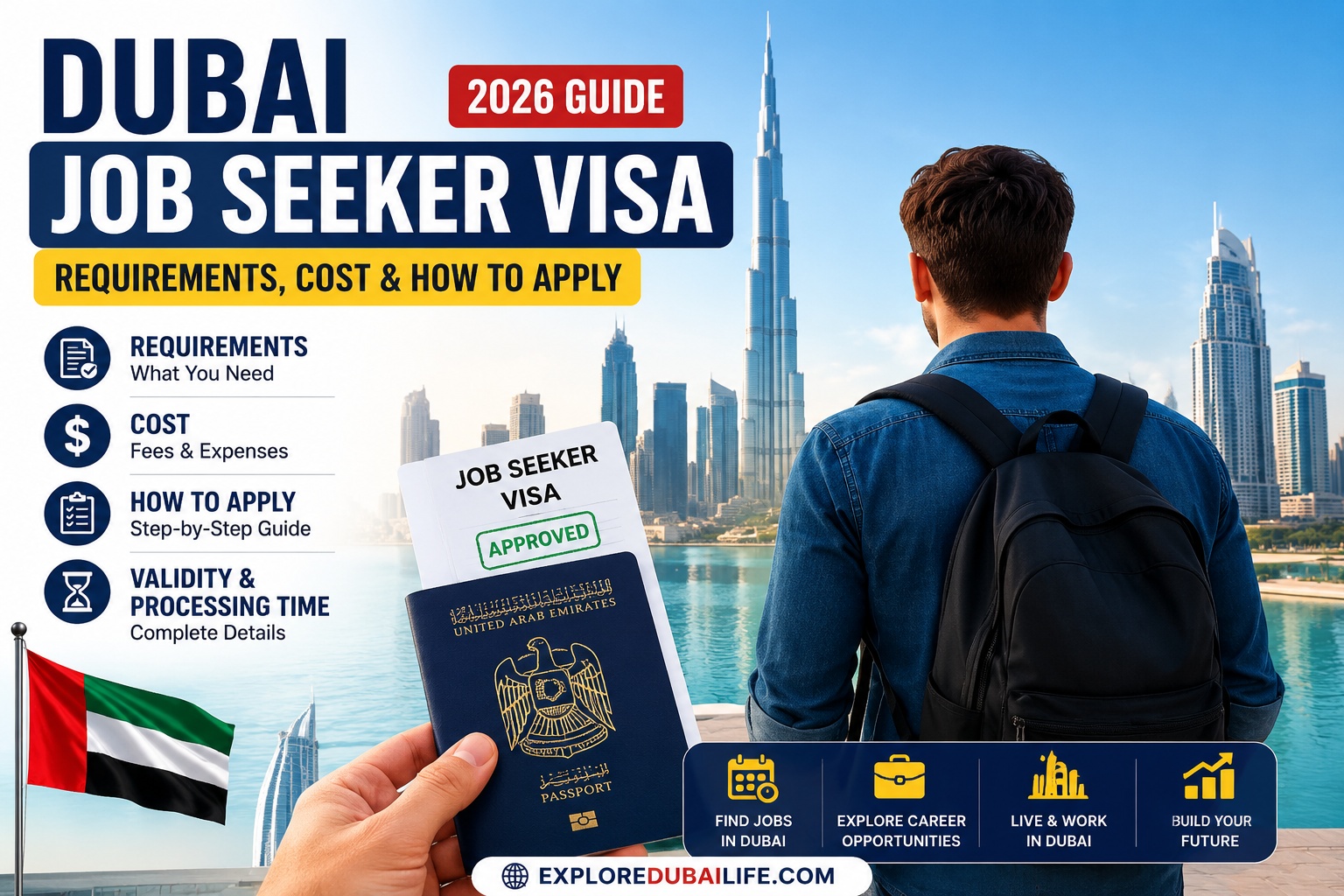
Moving to Dubai for work used to come with a frustrating catch-22: you needed a job to get a visa, but employers preferred candidates who were already in the country. The Dubai Job Seeker Visa solved that problem. It lets qualified professionals enter the UAE legally, attend interviews in person, and negotiate offers face-to-face all without an employer or sponsor backing the application.
If you’re planning a career move to the Gulf in 2026, this guide walks you through who qualifies, what it costs, which documents you’ll need, and how the application actually works — including the parts most blog posts gloss over, like the refundable deposit and what happens after you land a job offer.
What Is the Dubai Job Seeker Visa?
The Dubai Job Seeker Visa (officially a “visit visa to explore job opportunities,” and often called the UAE Job Seeker Visa or Job Search Visa UAE) is a single-entry permit that allows foreign professionals to stay in the UAE for 60, 90, or 120 days while they look for work.
Two things make it different from a tourist visa:
- No sponsor needed.
Most UAE entry permits require a host — a hotel, a relative, or a company. This one doesn’t. You apply on your own through the federal ICP portal or, for Dubai specifically, through GDRFA (the General Directorate of Residency and Foreigners Affairs). - It signals intent.
Employers in the UAE labour market know exactly what this visa is for. Showing up on one tells recruiters you’re serious, available for immediate interviews, and ready to convert to a work visa quickly.
One thing it is not: a work permit. You cannot legally take up employment, freelance, or run a business on it. It exists purely to give you time on the ground to secure an offer. Once you’re hired, your employer handles the work visa and residence visa through MOHRE (Ministry of Human Resources and Emiratisation) and immigration authorities.
UAE Job Seeker Visa Eligibility: Who Qualifies?
This visa targets skilled professionals, not general labour. To qualify, you must meet one of these two routes:
Route 1 Professional skill level. You’re classified within MOHRE’s first, second, or third skill levels:
- Level 1: Legislators, managers, and business executives
- Level 2: Professionals in scientific, technical, and human fields (engineers, doctors, accountants, IT specialists, teachers)
- Level 3: Technicians in scientific, technical, and humanitarian fields
A bachelor’s degree or equivalent is the practical baseline here your qualification certificate is a core part of the application.
Route 2 Recent graduates from a top university. You graduated within the last two years from one of the world’s top 500 universities, based on the classification approved by the UAE Ministry of Education.
Beyond one of those two routes, you’ll need a valid passport (six months minimum validity), an attested degree certificate, and in some cases a financial guarantee to show you can support yourself during the stay.
Can Pakistanis Apply for a Dubai Job Seeker Visa?
Yes. The visa is nationality-neutral eligibility depends on your qualifications and skill classification, not your passport. Pakistani applicants apply through the same ICP or GDRFA channels as everyone else. The main practical consideration for applicants from Pakistan (and India, Bangladesh, the Philippines, and similar markets) is document attestation: your university degree needs to be attested by your home country’s Higher Education Commission and foreign ministry, then by the UAE embassy. Starting that process early it’s the single most common cause of delays.
Dubai Job Seeker Visa Requirements: Documents Checklist
Here’s what a complete application typically includes. These are the Dubai Job Seeker Visa documents most applicants need to prepare:
- Valid passport at least six months of remaining validity
- Passport-size photograph white background, meeting ICP photo specs
- Attested qualification certificate bachelor’s degree or higher, attested in your home country and by the UAE authorities
- Proof of top-500 university graduation (if applying under the recent-graduate route) with graduation date within the last two years
- Financial guarantee / refundable deposit — paid during the application, returned when you leave the UAE lawfully or convert to a residence visa
- Updated CV not always mandatory, but some channels request it
- Health insurance coverage for the duration of your stay (often bundled into the visa fee, depending on the channel)
A quiet tip from people who’ve been through this: make sure the name on your degree matches your passport exactly. A missing middle name or spelling variation between documents is a surprisingly frequent rejection trigger. If there’s a mismatch, get an affidavit or name-verification letter before applying, not after a rejection.
Dubai Job Seeker Visa Cost in 2026
Fees depend on the duration you choose. As a benchmark, the ICP fee schedule has listed the following totals, which include the refundable security deposit of roughly AED 1,025 plus insurance:
| Duration | Approximate Total Fee (AED) | Approx. USD | Best For |
|---|---|---|---|
| 60 days | ~1,495 | ~$407 | Candidates with interviews already lined up |
| 90 days | ~1,655 | ~$450 | Most applicants — comfortable buffer |
| 120 days | ~1,815 | ~$494 | Career changers or competitive fields |
A few important notes on cost:
- The deposit is refundable.
A chunk of what you pay is a security deposit, returned when you exit the UAE on time or transition to a work visa. Don’t treat the full fee as a sunk cost. - Third-party agencies charge more.
Typing centres and travel agencies add service fees, sometimes several hundred dirhams. Applying directly through ICP Smart Services or the GDRFA website is the cheapest route - Fees change.
UAE authorities have adjusted this fee schedule more than once, including updates in 2026. Always verify the current amount on the official ICP portal before paying, and be sceptical of any site quoting a “guaranteed” price. - Budget beyond the visa.
Factor in flights, accommodation for 2–4 months, and daily living costs in Dubai, which realistically means AED 8,000–15,000+ depending on your lifestyle. The visa gets you in the door; your savings keep you there.
How to Apply for Dubai Job Seeker Visa: Step-by-Step
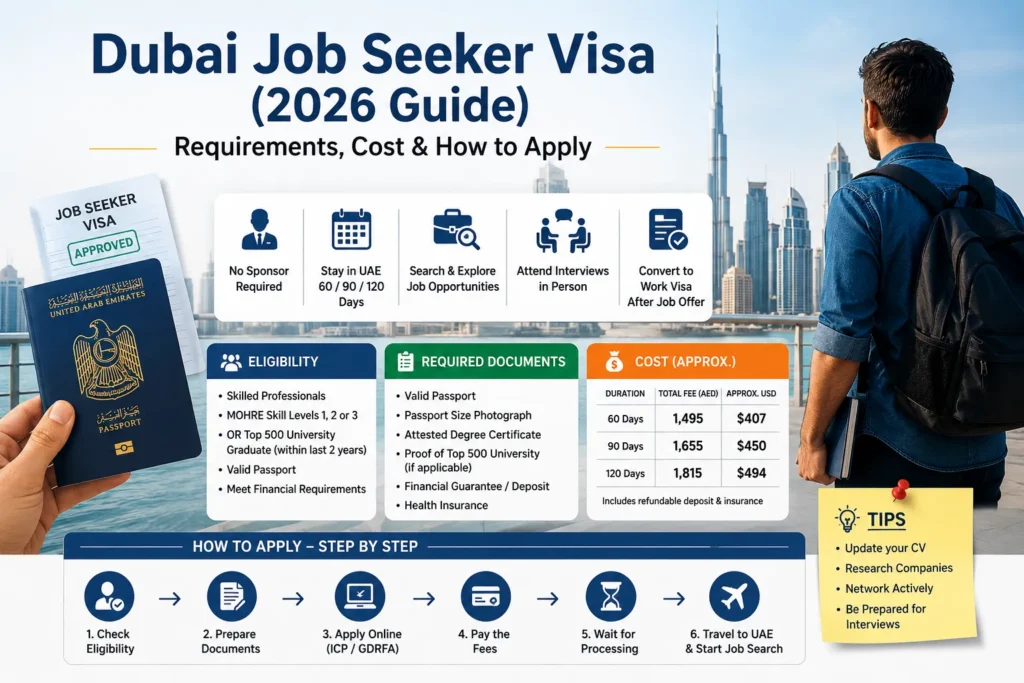
The process is fully online and doesn’t require an in-person visit. Here’s how to apply for a Dubai Job Seeker Visa in 2026:
Step 1: Choose your channel
Apply through the ICP Smart Services portal (icp.gov.ae) for any emirate, or through GDRFA Dubai (gdrfad.gov.ae) if your job search is centred on Dubai. Both are official; the outcome is the same entry permit.
Step 2 Create an account and select the service.
Look for the “visit visa to explore job opportunities” or jobseeker entry permit service, then pick your duration: 60, 90, or 120 days.
Step 3 — Fill the visa application and upload documents
Passport copy, photo, attested degree, and any supporting documents. Double-check every field against your passport — errors here cause rejections more often than eligibility issues do.
Step 4 — Pay online.
Fee plus refundable deposit, paid by card through the portal.
Step 5 — Track and receive your e-visa.
Approved permits are issued electronically as a PDF. Print a copy and keep the digital version on your phone for airport immigration.
Step 6 — Enter the UAE and start your search.
The clock starts when you enter. It’s a single-entry permit, so if you leave the UAE mid-stay, the visa lapses — plan any regional travel for after you’ve secured your work visa.
Dubai Job Seeker Visa Processing Time
Most applications are processed within 2 to 5 working days when documents are complete and correctly attested. During busy hiring seasons (typically September–November and January–March), it can stretch to one or two weeks. Build that buffer into your travel plans, and never book non-refundable flights before the e-visa is in hand.
Job Seeker Visa vs.Tourist Visa vs. Work Visa
A lot of people ask whether they can just job-hunt on a tourist visa. Technically you can attend interviews on one, but the comparison below shows why the job seeker route is usually the smarter play for serious candidates:
| Feature | Job Seeker Visa | Tourist Visa | Work (Employment) Visa |
|---|---|---|---|
| Sponsor required | No | Sometimes (hotel/host) | Yes — employer |
| Typical validity | 60/90/120 days | 30–60 days | 2 years (renewable) |
| Can legally work | No | No | Yes |
| Signals job-search intent to employers | Yes | No | N/A |
| Converts to residence visa in-country | Yes, via employer | Possible but messier | Is the residence pathway |
| Eligibility bar | Skilled professionals (MOHRE levels 1–3 or top-500 grads) | Open to most nationalities | Job offer required |
The practical advantage is time and credibility. Four months on a 120-day permit gives you room to interview across multiple companies, negotiate properly, and complete the medical and Emirates ID formalities without visa-run stress.
Tips to Make the Most of Your Job Search Window
Getting the visa is the easy part. Converting your stay into an offer is where preparation pays off:
Start applying before you fly.
Line up first-round calls on LinkedIn, Bayt, GulfTalent, and Naukrigulf while still at home. Arrive with interviews scheduled, not with a blank calendar.
Target the right sectors.
In 2026, hiring momentum in the UAE labour market is strongest in technology, fintech, healthcare, construction and real estate, logistics, tourism, and financial services. Skilled professionals in these fields see the fastest conversions from interview to offer.
Mention your visa status in applications.
“Currently in Dubai on a job seeker visa, available for immediate interviews” is a genuine advantage over overseas applicants. Recruiters move faster on candidates who don’t need relocation logistics.
Get your documents conversion-ready.
Once an offer lands, your employer will need your attested degree and passport for the work permit. Having everything ready can shave weeks off the process.
Watch the calendar.
Overstaying triggers daily fines and can jeopardise your deposit and future UAE immigration applications. If the offer hasn’t landed by the two-thirds mark of your visa, decide early whether to exit on time or check whether an extension is available through GDRFA for your permit type.
FAQs: Dubai Job Seeker Visa
Can I work on a Dubai Job Seeker Visa?
No. It’s strictly a job-search permit. Working — including freelancing or remote gigs for UAE clients — is illegal on this visa and carries fines, deportation risk, and bans. Once hired, your employer must secure a work permit through MOHRE before your first working day.
How long is the Dubai Job Seeker Visa valid?
You choose at application: 60, 90, or 120 days from entry. It’s single-entry, so exiting the UAE ends the permit even if days remain.
Can I convert a Job Seeker Visa into a work visa?
Yes — this is the whole point of the visa. Once you accept a job offer, your employer applies for your work permit and residence visa, and your status is changed inside the country. No exit or re-entry is required in most cases.
What documents are required for a Dubai Job Seeker Visa
A valid passport (6+ months), passport photo, attested bachelor’s degree or higher, proof of recent graduation from a top-500 university (if applying via that route), and the financial guarantee paid during application. Some channels also request a CV and insurance.
Who is eligible for the UAE Job Seeker Visa?
Professionals classified in MOHRE skill levels 1–3, or graduates from the world’s top 500 universities who finished their degree within the past two years.
Can Pakistanis apply for a Dubai Job Seeker Visa?
Yes. There are no nationality restrictions. Pakistani applicants should prioritise HEC and UAE embassy attestation of their degree, since unattested certificates are the most common stumbling block.
Is the Dubai Job Seeker Visa worth it?
For skilled professionals with in-demand experience and 3–4 months of living expenses saved, yes — being physically present dramatically improves interview conversion rates in the UAE, where employers favour candidates they can meet in person. For those without a degree, limited savings, or roles outside MOHRE levels 1–3, a conditional job offer from abroad may be the more realistic path.
What happens if I don’t find a job before the visa expires?
You must exit the UAE before the permit lapses. Your security deposit is refunded after lawful exit. You can apply for a new job seeker visa later, and GDRFA Dubai lists an extension service for some cases — check current rules on the official portal.
Key Takeaways: Your Action Plan
The Dubai Job Seeker Visa is one of the most practical routes into the Gulf job market in 2026 but it rewards preparation. Here’s your checklist:
- Confirm eligibility first. Match yourself against MOHRE skill levels 1–3 or the top-500 university route before spending a dirham.
- Attest your degree now. This takes weeks, not days, and it’s the number-one delay factor.
- Verify current fees on the official ICP or GDRFA portal third-party sites frequently publish outdated numbers.
- Pick 90 or 120 days unless you already have final-round interviews scheduled. The extra weeks cost little relative to a wasted trip.
- Apply online directly through ICP Smart Services or GDRFA Dubai to avoid agency markups.
- Land with interviews booked, documents conversion-ready, and enough savings to cover your full stay.
Do those six things, and you’ll arrive in Dubai not as a hopeful visitor, but as a candidate employers can hire next week. That difference is exactly what this visa was designed for.
Disclaimer: Visa fees, requirements, and processing times are set by UAE authorities (ICP, GDRFA, MOHRE) and can change without notice. Always confirm current details on the official government portals before applying.