
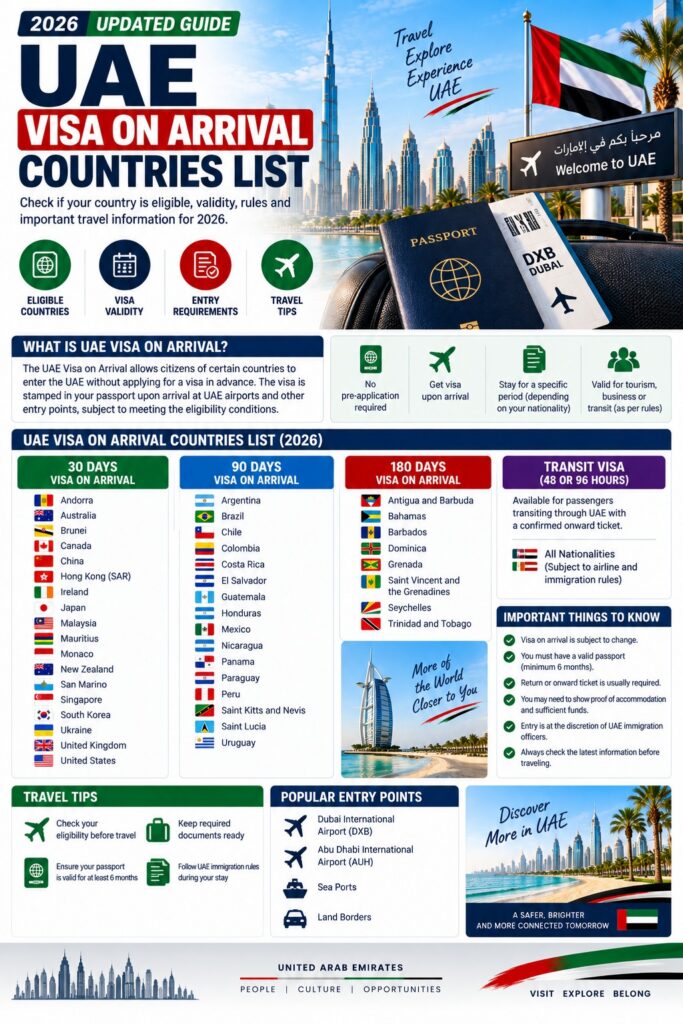
More than 90 nationalities will be visiting the UAE in 2026 without a prior visa. This includes 5 GCC countries with visa-free entry, around 20 countries with 30 days visa on arrival, more than 50 countries with 90 days visa on arrival, Mexico with 180 days visa on arrival, and 6 newly added nationalities (Indonesia, Vietnam, Thailand, the Philippines, Kenya, and South Africa), who qualify for 14 or 60 days visa on arrival if they hold a valid residence permit from an approved country.
There is also a specific rule for Indian citizens to receive a 14-day visa on arrival.If your nation is not on any of the lists below, you’ll need to apply for a UAE tourist visa online before you fly.
What Is a UAE Visa on Arrival?
A UAE visa on arrival, also known as a Dubai entry visa on arrival, is a visa that you get at the airport, rather than applying online before your travel. You land in the UAE, walk to the immigration counter, show your passport, and get stamped in.
This is different from a UAE tourist visa, which you will need to apply for and get approved before you visit. Visa on arrival is faster and easier, but is limited to citizens of specified countries.
Laws can change without the smallest sign, so always double-check your eligibility with the UAE Federal Authority for Identity and Citizenship.
GCC Countries: Visa-Free Entry (No Visa Needed at All)
Citizens of Gulf Cooperation Council (GCC) countries do not need a visa on arrival or any visa at all. You need a valid passport or national ID card.
- Bahrain
- Kuwait
- Oman
- Qatar
- Saudi Arabia
It is an independent and more liberal policy than visa on arrival and is based on GCC bilateral arrangements.
UAE Visa on Arrival Countries List: 90 Days
Free multiple-entry visa on arrival for nationals of the below countries, valid for 90 days and issued at the airport. The visa is valid for 6 months from the date of issue; however, you can stay in the UAE for a maximum of 90 days in total within that time on one or more visits.
Europe: Albania, Austria, Belgium, Bulgaria, Croatia, Cyprus, Czech Republic, Denmark, Estonia, Finland, France, Georgia, Germany, Greece, Hungary, Iceland, Italy, Latvia, Liechtenstein, Lithuania, Luxembourg, Malta, Montenegro, Netherlands, Norway, Poland, Portugal, Romania, Slovakia, Serbia, Russia, Slovenia, Spain, Sweden, Switzerland
Americas: Argentina, Bahamas, Barbados, Brazil, Chile, Colombia, Costa Rica, El Salvador, Honduras, Paraguay, Peru, Uruguay
Other countries: Belarus, Israel, Kiribati, Maldives, Mauritius, Nauru, Saint Vincent and the Grenadines, Seychelles, Solomon Islands
UAE Visa on Arrival Countries List: 30 Days
Citizens of these countries get a 30-day visa on arrival, which can usually be extended once for another 30 days through GDRFA or an Amer Service Centre.
- Andorra
- Australia
- Brunei
- Canada
- China
- Hong Kong
- Ireland
- Japan
- Kazakhstan
- Macau
- Malaysia
- Mauritius
- Monaco
- Mongolia
- New Zealand
- San Marino
- Singapore
- South Korea
- Ukraine
- United Kingdom
- United States
- Vatican City
This group includes some of the world’s most-traveled passport holders, including the United States, United Kingdom, Australia, Japan, and Canada.
UAE Visa on Arrival: 180 Days
Mexico is the only country whose citizens receive a visa on arrival valid for 180 days, making it the longest visa-on-arrival period the UAE offers.
New Countries Added to UAE Visa on Arrival in 2026
Starting June 25, 2026, the UAE expanded its visa-on-arrival program to include six new nationalities:
- Indonesia
- Vietnam
- Thailand
- The Philippines
- Kenya
- South Africa
Important condition: Simply holding a passport from one of these six countries is not enough. To use this visa on arrival, you must also hold a valid, current residence permit from one of the following approved countries or regions:
- United States
- United Kingdom
- European Union member states
- Canada
- Australia
- New Zealand
- Japan
- Singapore
- South Korea
If you meet both conditions, you and your accompanying family members can get either a 14-day visa on arrival (extendable once) or a 60-day visa on arrival (single stay, not extendable).If you’re a citizen of these six countries but don’t hold a qualifying residence permit, you will still need to apply for a UAE visit visa online before you travel.
UAE Visa on Arrival for Indian Citizens
India has its own special rule. Indian passport holders can get a 14-day visa on arrival if they already hold one of the following:
- A valid visa or residence permit from the United States
- A valid visa or residence permit from the United Kingdom
- A valid visa or residence permit from an EU member state
- A valid visa or residence permit from Canada, Australia, New Zealand, Japan, Singapore, or South Korea
The supporting document generally needs at least 6 months of validity remaining from your UAE entry date. Without a qualifying visa or permit, Indian citizens need to apply for a regular UAE tourist visa in advance.
Who Is NOT Eligible for UAE Visa on Arrival?
Most nationalities not listed above must apply for a UAE tourist visa online before traveling. This includes citizens of countries such as:
- Pakistan
- Bangladesh
- Nigeria
- Sri Lanka
- Nepal
- Egypt
- Most other African and Asian countries not mentioned above
If this applies to you, you can apply for a UAE tourist visa (usually 14, 30, or 60 days) online, and approval typically takes 24 to 48 hours.
How to Get a UAE Visa on Arrival: Step by Step
- Find out if you qualify. Please check if your country is on the current visa on arrival list.
- Have your papers ready. Please show your passport (minimum 6 months validity), a secured return or onward flight ticket, and hotel booking verification.
- land of UAE. Fly to Dubai International Airport or Abu Dhabi International Airport, for example.
- Go to the immigration desk. For non-UAE resident guests, please queue up.
- Show your documents and passport. If you are from one of the new nations added to the list or one of the conditional countries of India, bring your qualifying resident permit or visa too.
- Stamp down. When you arrive, the immigration official stamps your visa directly into your passport. No paperwork, no advance application.
Read Also: UAE Investor Visa 2026
Documents You Need for UAE Visa on Arrival
- Passport with a minimum of 6 months’ validity from the date of entry
- Return or onward confirmed flight ticket
- Proof of hotel reservation or accommodation address
- Verification of proper money (often a bank card is enough)
If you are in one of the conditional 2026 countries (Indonesia, Vietnam, Thailand, Philippines, Kenya, South Africa or India), you will require a valid qualifying visa or resident permit.
Read Also: How to Convert a Visit Visa to a Work Visa
UAE Visa on Arrival Fees and Overstay Fines
For the nations coming within the 30-day, 90 day and 180-day categories, there is no payment for a visa on arrival. You pay nothing at the immigration counter.
If your visa is expired, you will be charged AED 50 per day by the UAE, beginning from day one. No grace period, so make sure you leave or extend your visa before it expires.
Read Also: UAE Emirates ID Guide
Final Words
UAE visa on arrival countries list is constantly growing as the country welcomes more and more people every year. Whatever your reason for flying into Dubai whether it’s for holidays, business, or to visit family knowing your category before you fly will save you time, money, and disappointment at the airport.